

Nationwide Study Finds Homeschool Students Achieve Strong Academic Results Across the United States
By Brian D. Ray, Ph.D.
President, National Home Education Research Institute (NHERI)
July 15, 2025
This article was graciously provided by Brian Ray, Ph.D. of the National Home Ecucation Research Institute (NHERI). It first ran in the fall 2025 issue of Homeschool New York’s publication, The Messenger Magazine. To learn more about NHERI, visit their website at www.nheri.org.
The newest nationwide study, presented at the International School Choice and Reform Conference in Madrid, Spain (Ray & Hoelzle, 2024), offers important insights into the academic performance of homeschooled students in the United States. Conducted by Dr. Brian Ray (of the National Home Education Research Institute, www.nheri.org) and Dr. Braden Hoelzle, this large-scale analysis shows that home-educated students, on average, score well above national norms on standardized academic achievement tests—continuing a trend observed in previous research (Ray, 2017; Rudner, 1999).
The findings challenge some critics’ claims that homeschooling lacks academic rigor. Instead, the data suggest that parent-directed, home-based education is producing strong academic outcomes across diverse families and contexts.
STUDY’S PURPOSE AND SCOPE
The research set out to answer three primary questions:
- How do K–12 homeschool students perform academically on standardized achievement tests?
- What family, educational, or demographic factors correlate with their academic success?
- Why do parents choose homeschooling today?
To answer these questions, the researchers gathered data from homeschool families across 45 states. Recruitment occurred through homeschool associations, state-level organizations, social media outreach, and snowball sampling methods. Academic scores were collected from three major standardized testing services, providing a robust dataset that reflects the experiences of homeschoolers nationwide.
A DIVERSE AND GROWING HOMESCHOOL COMMUNITY
The demographic data from this study paints a picture of a diverse homeschooling population. Median family income for these homeschool families was similar to the U.S. median for households with children ($96,000 in 2023; Statista.com, 2025). Parents’ educational backgrounds varied widely, with some having high school diplomas and others holding graduate degrees.
In terms of ethnic and racial background, homeschooled students included a range of groups, though a majority identified as White (83%), followed by Hispanic (8%), Black (2%), Asian or Pacific Islander (3%), and other groups (4%). (See also, United States Department of Education, 2021.) This diversity reflects the increasing accessibility of homeschooling across a variety of family types and communities in the United States.
ACADEMIC RESULTS: HOMESCHOOL STUDENTS SCORED VERY HIGH
The study confirmed that homeschooled students are performing strongly on standardized tests in reading, language, math, science, and social studies. Their scores are well above national averages across these subject areas. Without statistically controlling for variations in demographic variables, the test percentile scores of the homeschooled and non-homeschooled are presented in the table.
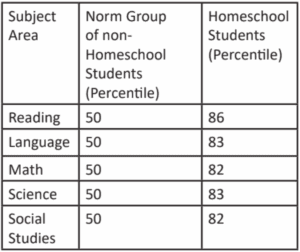
These results align with decades of prior research showing that homeschooled students tend to achieve at high academic levels on standardized tests.
Interestingly, the statistical models revealed that few demographic factors meaningfully predicted student achievement. In contrast to public schooling, where factors like parental education and household income often heavily influence student outcomes, these variables had only minor correlations among homeschoolers. This suggests that the homeschooling environment itself may help equalize academic opportunities across different family circumstances.
WHAT FACTORS WERE LINKED TO ACADEMIC PERFORMANCE?
While the overall picture was one of academic success across a wide range of families, a few variables did show modest correlations with scores on standardized academic achievement tests:
- Earlier Start to Formal Instruction: Students who began formal instruction at younger ages showed slightly higher scores in reading, language, and math—gaining about 2 to 4 percentile points for each earlier year of instruction. It is not surprising that earlier formal instruction would be related to higher scores on tests.
- Amount of Structured Learning Time: More structured academic time during the day was linked with modestly higher scores, particularly in language and math. It is also not surprising that more structured academic time would be related to higher scores on tests.
- Household Income and Parental Education: Higher family income and greater parental education were associated with higher scores in some subjects, although the effects were much smaller than commonly observed in studies of public school students.
- State Regulation: Students in states with the least homeschooling regulation scored higher in some academic areas—especially math, science, and social studies—compared to students in states with low levels of regulation. Interestingly, moderate and highly regulated states did not show the same pattern. This finding may suggest that more government regulation and control of homeschooling does not necessarily enhance academic outcomes and that parental autonomy plays a positive role.
In summary, while several factors had some predictive value, the models showed that most variables only explained a small portion of academic outcomes. This suggests that the homeschooling environment and approach, themselves, where individualization and parental involvement play central roles, are effective in enhancing academic achievement (as measured by standardized tests).
PARENTS’ REASONS FOR HOMESCHOOLING
Though the primary focus of this study was on academic outcomes, the researchers also collected data on why families choose homeschooling.
Consistent with previous studies, reasons included:
- The ability to provide a personalized, child-centered education
- The desire to transmit family values and faith
- Concerns about the school environment, including safety and peer influences
- Dissatisfaction with public or private school academic quality
These motivations highlight the deep investment parents have in tailoring education to their children’s needs and their family’s values.
IMPLICATIONS FOR EDUCATION POLICY AND RESEARCH
This study updates the academic achievement literature on homeschooling with one of the most extensive datasets in over a decade. The results suggest that, on average, homeschool students are thriving academically, and that traditional demographic risk factors have far less predictive power in the setting of parent-directed home-based education than they do in public schooling.
While the study was not designed to carefully directly compare homeschooling achievement results to those of public schooling, it raises important questions for future research. The authors plan to pursue comparisons with large-scale public school data to further contextualize their findings.
For education policymakers, the study provides little evidence to justify more restrictive homeschooling regulations in the United States based on academic concerns. In fact, academic achievement was often highest in states with the least regulatory burden, suggesting that parental freedom and flexibility can foster strong educational outcomes. Further, previous research has found no statistically significant correlation between the degree of government control of private homeschooling and the academic learning of homeschool students (Ray, 2010).
CONCLUSION
In a time when some critics argue for stricter control over home education, this nationwide study provides strong evidence that homeschool students are not only keeping pace academically—they are excelling. The academic achievement of these students spans a wide range of family backgrounds and state contexts, reinforcing the idea that homeschooling is a powerful educational option for many families.
As homeschooling continues to grow and diversify across the United States, studies like this help clarify its strengths and dispel misconceptions. The evidence suggests that when parents are empowered to direct their children’s education, those children are well-equipped to succeed academically and beyond.
ABOUT THE AUTHOR AND THE NATIONAL HOME EDUCATION RESEARCH INSTITUTE
Dr. Brian D. Ray is president of the National Home Education Research Institute (www.nheri.org) and is internationally known for his research on homeschooling (home education). He has published many peer-reviewed articles, books, and chapters in books. Dr. Ray holds a B.S. in biology from the University of Puget Sound, an M.S. in zoology from Ohio University, and a Ph.D. in science education from Oregon State University. He serves as an expert witness in courts and legislatures, is a former professor of science and education at the undergraduate and graduate levels, and has taught in public schools, private schools, and homeschool groups.
Solid, empirical, and verifiable research like that done by NHERI for 35 years is an essential support to homeschoolers and all people around the world who care about educational options and freedom. NHERI could use your support at https://nheri.org/donate/
Also, you may sign up for free homeschool research news at https://nheri.org/


Scan the QR code above to donate to NHERI.
References
- Ray, Brian D. (2010, February 3). Academic achievement and demographic traits of homeschool students: A nationwide study. Academic Leadership Journal, 8(1), https://scholars.fhsu.edu/alj/vol8/iss1/7/
- Ray, Brian D. (2017). A systematic review of the empirical research on selected aspects of homeschooling as a school choice. Journal of School Choice: International Research and Reform, 11(4), 604-621, https://nheri.org/a-systematic-review-of-the-empirical-research-on-selected-aspects-of-homeschooling-as-a-school-choice/
- Ray, Brian D., & Eagleson, Bruce K. (2008, August 14). State regulation of homeschooling and homeschoolers’ SAT scores. Journal of Academic Leadership, 6(3). Retrieved June 15, 2018 from https://scholars.fhsu.edu/alj/vol6/iss3/17/
- Ray, Brian D., & Hoelzle, Braden. (2024). Reasons for homeschooling and the correlates of home-educated students’ academic achievement: A new U.S. nationwide study. Paper presented at the annual International School Choice and Reform Conference, Madrid, Spain, January 4-7, 2024.
- Rudner, Lawrence M. (1999). Scholastic achievement and demographic characteristics of home school students in 1998. Educational Policy Analysis Archives, 7(8), https://epaa.asu.edu/index.php/epaa/article/view/543
- Statista.com. (2025). Median annual family income in the United States in 2023, by state (in U.S. dollars), https://www.statista.com/statistics/236804/median-family-income-in-the-united-states-by-state/
- United States Department of Education. (2021). Parent Survey and Parent and Family Involvement in Education Survey of the National Household Education Surveys Program, https://nces.ed.gov/programs/digest/d21/tables/dt21_206.10.asp